Welcome to My Website

Powered by Blogger.

Ads 468x60px

Followers

Featured Posts

Social Icons

Play Station

Popular Posts

Pages

Random Post

Random Post

Hot Games

Random Post

Random Post

Recent Posts

Donald Mcvey, Helped Sell Coral Springs

Posted by Unknown Saturday, 4 June 2016 0 comments

Services will be today for Donald F. McVey, described by associates as a crackerjack salesman who helped James Hunt sell Coral Springs.

Mr. McVey died on Wednesday. He was 91.

``He had a good line of chatter, `hail fellow well met,` you know,`` former Coral Ridge Properties executive Robert Hoffman said. ``Nobody was a stranger to him. He was really a good salesman.``

Mr. McVey was born in North Dakota and was in the Marine Corps preparing to go overseas when World War I ended, his wife, Virginia, said.

He spent more than 30 years in the automobile business, working for companies from Packard to Chrysler as a sales manager in Detroit and, later, Dallas.

It was through the car business that Mr. McVey met Hunt, who went on to form Coral Ridge Properties, the company that created Coral Springs. A later chance encounter with Hunt`s son on an airplane led to a call from Hunt that sent Mr. McVey and his family to Fort Lauderdale in 1957.

There, he worked for Coral Ridge, first selling properties in eastern Broward County before moving on to Coral Springs, which was founded in 1963. He later worked for the General Development Corporation as a sales manager.

Mr. McVey went blind from glaucoma shortly after he retired around 1970, his wife said.

In addition to his wife of 54 years, Mr. McVey is survived by two sons, Dr. James P. McVey of Rockville, Md., and Donald F. McVey of St. Petersburg; two daughters, Mary Ellen Shearer of Birmingham, Mich., and Sally Ann Duncan of Stuart; 14 grandchildren; and 12 great-grandchildren.

Services will be at 1:30 p.m. today at Fairchild North Funeral Home, 299 N. Federal Highway, Fort Lauderdale. Burial will be Lauderdale Memorial Park.

Niki Lauda, the subject of the Formula One film Rush, talks to John Hiscock about his great rival James Hunt and explains why he agreed to the film

Former Formula One world racing car champion Niki Lauda estimates he has been approached 30 times over the years by people wanting to tell his story.

But it was not until the British playwright and screenwriter Peter Morgan (The Queen, Frost/Nixon) contacted him that he finally agreed. "Oscar nominations, good writer, top man," he told me succinctly when we talked at the Toronto Film Festival. "I started talking to him and he developed the story about the 1976 racing season and the rivalry between me and James Hunt."

The result is Rush, which had its premiere in Toronto and is being widely viewed as a possible Oscar contender. The Australian actor Chris Hemsworth does a creditable job portraying Hunt, the hard-living, fast driving playboy who died of a heart attack in 1993 aged 45, while Daniel Brühl, who is also in the Julian Assange story The Fifth Estate, portrays the methodically brilliant Lauda.
Daniel Brühl, playing Lauda, with Ron Howard on the set of Rush
Daniel Brühl, playing Lauda, with Ron Howard on the set of Rush Credit: Jaap Buitendijk
Lauda, the defending Formula One champion, was critically burned when his Ferrari crashed at the Nürburgring, but only six weeks after the near-fatal crash he returned to the track. He retired at the end of the 1985 season and ran his own airline, Lauda Air, before selling it to Austrian Airlines in 2000.
 
"I had to ask my wife who Daniel Brühl was, to be honest," said 64-year-old Lauda. "She told me right away, then I met him and I liked the guy right from the beginning. He said it was very difficult to play me because I was still alive and people knew me from television and knew my body language. I spent a lot of time in Vienna with him and then I flew him to the Brazilian Grand Prix to show him Formula One racing because he had very little knowledge of it.

"I think he did an incredible job because when I first saw the movie, I said, 'S---! That's really me.'"
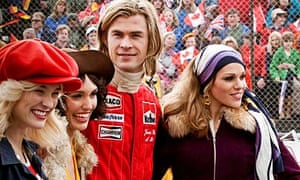
Chris Hemsworth as James Hunt and Daniel Bruhl as Niki Lauda in 'Rush'
Chris Hemsworth as James Hunt and Daniel Bruhl as Niki Lauda in 'Rush' Credit: REX/Snap Stills
Rush was directed by Oscar-winner Ron Howard, who, said Lauda, knew nothing at all about motor racing. "It was really funny because he had no idea about racing at all and he was like a little kid – he couldn't stop asking questions. Then the whole thing came into gear."

Although the film portrays Lauda and Hunt as two drivers who disliked each other in the early days of their careers, Lauda told me that in fact they used to go out on the town in London together and on at least one occasion he spent the night in Hunt's flat. Then he added with a smile and a wink: "But not together. There were four of us."
 
On the track, he said, Hunt was a tough competitor. "There are good drivers and bad ones and then there are the really talented ones who are difficult to beat and James was one of them. We respected each other very much because in the old days, to drive 300 kilometres an hour side by side towards a corner, if someone makes a mistake, one or both are killed. Hunt was someone you could rely on to be really precise.

"The sad thing is that he isn't here now. I wish he could have seen the movie because I know for sure he would have enjoyed it."

James W. Hunt, 75, a decorated Army brigadier general who retired in 1986, died Jan. 23 at Heart Homes at Bay Ridge, an assisted-living facility in Annapolis. He had posterior cortical atrophy, or Benson's syndrome, a form of Alzheimer's disease.

Gen. Hunt joined the Army in 1954 and served in Vietnam. He reached the rank of brigadier general in 1982, and his last active duty assignment was as the deputy chief of staff for intelligence for the U.S. Army Forces Command at Fort McPherson, Ga.

His military decorations include the Distinguished Service Medal, three awards of the Legion of Merit, two awards of the Bronze Star Medal and the Army Commendation Medal.

James Williams Hunt was born in Cortland, N.Y. He received a bachelor's degree in military studies from the University of Maryland in 1966 and a master's degree in political science from Auburn University in 1976.


He had been an Annapolis resident since 1987 and was a past chairman of the council for the golf courses at Fort Meade. 
Survivors include his wife of 56 years, Sandra Taylor Hunt of Annapolis; three children, Deborah Brungardt of Gaithersburg, Robert Hunt of Stuttgart, Germany, and Thomas Hunt of Los Angeles; two sisters, Nancy Stabley of Webster, N.Y., and Cynthia Titus of Locust Grove, Va.; three grandchildren; and one great-grandson.


Chris Hemsworth portrays James Hunt in Rush with the shallowness of the cartoon figure. Photograph: Rex/Snap Stills

Friday 6 September 2013 17.04 BST Last modified on Monday 4 April 2016 18.01 BST

It was Jackie Stewart who gave the old Nürburgring a nickname: the Green Hell. He hated the 14-mile circuit in the Eifel mountains. But that wasn't good enough for Peter Morgan. When the writer of Frost/Nixon and The Queen came to create his screenplay for Rush, the new film about the rivalry between James Hunt and Niki Lauda, a more dramatic introduction was needed for the location of Lauda's terrible crash in 1976.

"In Formula One," a TV commentator announces in the film, setting the scene for the near-fatal weekend, "it is known as the Graveyard."

Well, no, it isn't. And it wasn't, even in 1976. Yes, five drivers died there during grand prix meetings. A terrible toll, of course. But at Monza, to take just one example, the equivalent figure was 10 drivers – and more than 40 spectators. These were dangerous and scary circuits but no one in the sport would have been so crass as to call them "graveyards".

Ron Howard, the director of Rush, wants everyone to know that his film is "a movie, not a documentary". Which is the usual excuse, sometimes justified, for manipulating the facts and the structure of a true story to fit the format of a feature film intended to attract a popular audience.

At their best – and Morgan's work on The Queen certainly qualified as an outstandingly brilliant example – such films can illuminate facets of reality. It would be unduly generous, however, to suggest that Rush was brought into existence to probe for deeper truths beneath the surface of its story. What it wants to do is entertain its audience by portraying an historic sporting rivalry in the most vivid way possible, using its £50m budget to turn up the noise and the colour. Its immediate reward has been a series of rave reviews in film magazines from Empire to the Hollywood Reporter.

Countless projects aimed at making films about grand prix racing have failed to get off the ground over the years. But the worldwide success of the Senna documentary of 2010, with its jolting cockpit footage, its brilliant editing and its charismatic hero, may have opened the way for Rush to find an audience beyond the petrolheads.

There are many things in the new film's favour. One is Daniel Brühl's extraordinary portrayal of Lauda, with its harrowing depiction of his hospital ordeal and its hints of the real man beneath the brusque, dismissive surface. Another is the recreation of the racing itself: you would have to be the saddest of anoraks to find it necessary to complain about flaws in the period detail, from the hardware to the circuits, or about the blending of archive film with newly shot footage.
Advertisement

It's hard, however, to ignore fundamental untruths inserted simply to amp up the drama. Undermining the legitimacy of the whole film is the suggestion that Hunt and Lauda detested each other. In fact, they were good friends and far more alike in their appetites than Morgan allows us to know. Instead of searching for the real story, he has gone for the tabloid version.

Unlike Brühl, Chris Hemsworth never succeeds in evoking the real Hunt, settling for the shallowness of the cartoon figure – shagging, boozing, toking, snorting – depicted by the script. The scene in which he savagely beats up a reporter from a British newspaper is not just a fiction but a travesty.

After seeing Rush twice, and feeling vaguely dissatisfied, I went back in time to 1966 and watched Grand Prix, the result of John Frankenheimer's year among the grand prix circus. Already famous for The Manchurian Candidate, Frankenheimer wanted to make a fictionalised film about contemporary Formula One, and spent $9m of MGM's money shooting throughout the season, sometimes permitted to put a car carrying his camera in with the real competitors during practice sessions and, once or twice, at the start of the races themselves.

Not everyone welcomed their presence. "The Ferrari and BRM mechanics were constantly confused by MGM's set of film extras posing as mechanics," the correspondent of Motor Sport magazine noted in his report from Monaco. "Valuable space was taken up by cameras and equipment, the pits were overcrowded, the Brabham team had to become very short-tempered in order to get on with their work, while Team Lotus were being harassed by officials who wanted the pit-front cleared so that Hollywood could do some filming before the race began."
Advertisement

The result, a three-hour epic shown (like Ben Hur or Cleopatra) with an intermission, was a revelation. In those days there were no in-car TV cameras, so a lap of Monaco seen through the lens of a film camera attached to the nose of an F1 car at racing speed was new and thrilling, particularly when seen as part of a magnificent title sequence devised by the great Saul Bass. The cast included such first-rate actors as Yves Montand, Eva Marie Saint, Jessica Walter, James Garner and Brian Bedford, with bit-parts for Toshiro Mifune, Geneviève Page and Adolfo Celi. Oh, and Françoise Hardy.

Robert Alan Aurthur's script included a number of memorable exchanges and surprisingly few clunky bits, most of which occurred when a genuine grand prix driver, such as Graham Hill, was given something to say. Celi, playing the Enzo Ferrari character, had one of the best lines, filmed inside the real Ferrari factory while negotiating with Garner, playing an American driver called Pete Aron: "You confuse me, Aron. And I don't like men who confuse me driving my cars."

Given Morgan's record, it's a surprise that Rush should be so devoid of memorable dialogue. Justifying his occupation, Hunt is made to say: "Isn't that what we're here for? To stare death in the face and beat it? That's the nobility of it. It's like being knights." And when Lauda falls in love, he tells the girl: "Happiness is the enemy. It weakens you. Suddenly you have something to lose." Morgan has made his protagonists sound like characters in a teenage soap opera.

Not all the film's defects are the screenplay's fault. Howard must be blamed for the staggeringly unsubtle jump-cut from a naked Hunt, hard at it with one of his air hostesses, to a screen filled with cylinder-head valves going up and down. At that moment there is a yearning for a moment of sophistication, for the intervention of a poetic sensibility, perhaps for Eva Marie Saint saying "I love you" to Montand, and for his reply – "We will have to discuss the consequences of those terrible words" – as he packs his helmet and gloves, preparing to go out and die on the Monza banking.